
Minute Cryptic
Minute CrypticWord
4.414.00 Reviews
- Version
- 1.0.5
- Installs
- 100.00K
- Age Rating
- Teen
Screenshots
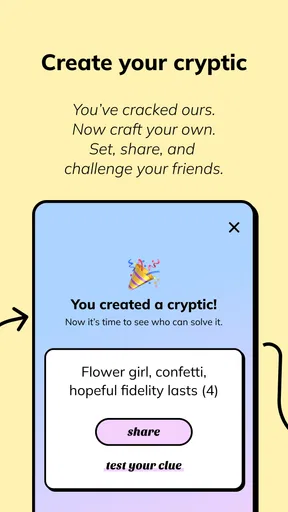
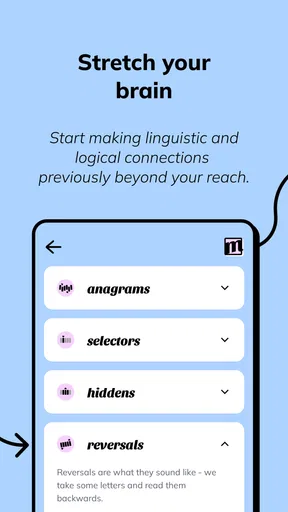
Our Review of Minute Cryptic
 Analysis by Appyee
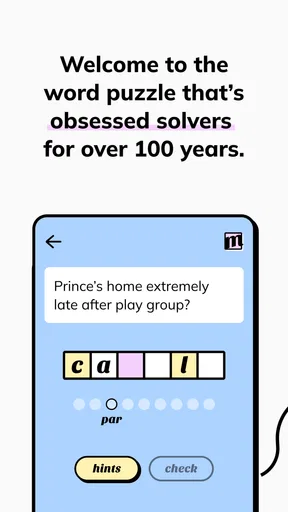
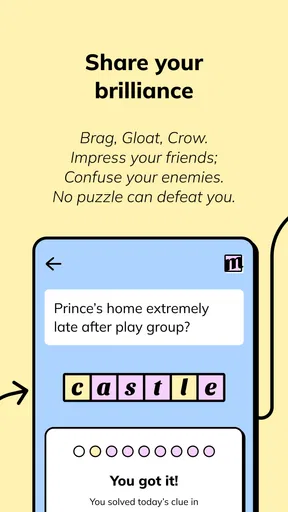
I approached Minute Cryptic expecting a quick word game, but its daily clue format asks for a little more attention than a typical anagram or guessing app. The basic idea is simple: you receive one cryptic clue and work toward its answer. The challenge comes from learning to read the clue as a compact puzzle rather than as an ordinary sentence. That makes each attempt feel small enough for a spare moment while still giving me a real sense of progress when the answer finally clicks.
Minute Cryptic is a free word game from Minute Cryptic, aimed at players who want an approachable introduction to cryptic clues rather than a long campaign or a noisy collection of unrelated mini-games. It carries a Teen content rating and runs on Android devices using version 7.0 or later. The current release is 1.0.5, and the game has already passed over one hundred thousand installs. Those details matter mainly because they make it easy to try without treating the download as a major commitment.
Getting comfortable with the daily clue
The first thing I would tell a new player is not to judge the game by the word “cryptic.” The clues can look intimidating if you are used to straightforward word searches, but the daily format keeps the task focused. You are not facing a huge board, a timer-filled arcade mode, or a dictionary-sized list of possible answers. You are concentrating on one carefully constructed line and trying to discover how its wording works.
That narrow focus is the game’s strongest design choice for beginners. I can open it during a coffee break, read the clue, make a few attempts, and leave without losing the thread of a larger session. It also gives the game a different rhythm from crossword apps that expect a long sitting. Here, the satisfaction comes from understanding one clue properly, not from clearing a screen packed with dozens of entries.
At the same time, “quick” should not be confused with “automatic.” Some clues may fall into place rapidly, while others require me to slow down and question every word. The game is most enjoyable when I accept that contrast. If I expect every daily puzzle to be solved instantly, I may mistake a normal cryptic challenge for a flaw. If I treat the clue as a short language exercise, the occasional pause becomes part of the appeal.
The game is especially suitable for people who enjoy wordplay, lateral thinking, or the feeling of decoding a sentence. It is less suitable for someone looking for a pure vocabulary test where knowing more words guarantees success. Cryptic clues often reward recognizing construction and misdirection, so a player with a modest vocabulary can still make progress by learning how the wording behaves.
The public response is encouraging without making the game seem universally settled: it holds a 4.4 average from around two hundred ratings, alongside fourteen written reviews. I read that as a promising sign for a relatively focused word title, but not as a reason to assume it will suit everyone. The best test is whether you enjoy examining language closely rather than simply producing words as quickly as possible.
What I would do before solving
After installing it, I would begin with a clear screen and a few uninterrupted minutes rather than opening it while multitasking heavily. Cryptic clues depend on noticing small changes in meaning. If I am replying to messages or listening to a conversation, I am much more likely to miss the useful part of the clue and then blame the puzzle for feeling opaque.
I would also keep a simple note nearby, either on paper or in a separate notes app, for candidate answers and fragments. This is not because the game requires an elaborate solving system. It is useful because writing down a possible definition, a promising letter group, or a suspicious short word prevents me from circling back to the same unproductive idea. The note becomes a scratchpad for reasoning rather than a place to record random guesses.
My first pass would be deliberately broad. I would read the clue once for its natural meaning, then read it again looking for the likely definition at one end. In many cryptic clues, the surface sentence is designed to suggest one story while the wordplay points somewhere else. Separating those two readings is the first meaningful skill a new player can practice.
I would not install the game expecting a large collection of settings or a conventional progression system. Its appeal is the daily puzzle itself. That simplicity is helpful when I want to get solving quickly, but it also means the experience will feel limited if I need constant unlocks, extensive customization, or a long-term game structure with many modes.
How to reach the first satisfying solve
My most reliable beginner workflow is to split the clue into two questions: what could the answer mean, and how might the answer be built? The definition is usually a word or phrase that describes the answer. The rest of the clue may indicate an anagram, a hidden word, an abbreviation, a reversal, or another form of wordplay. I do not need to identify the entire mechanism immediately. Finding one plausible side of the clue is enough to start.
For example, I might first notice that the final word appears to define something, while the earlier wording feels oddly specific. Instead of treating that oddness as decoration, I would inspect it for useful instructions. A word suggesting disorder may point toward rearrangement. A word implying containment may tell me to look inside another word. Short connecting words can also matter, even when they seem unimportant in ordinary conversation.
The practical tip that helped me most was to avoid entering a guess simply because it matches the definition. A candidate answer should also have a credible explanation for the wordplay. If I cannot account for the clue’s unusual wording, I treat the answer as provisional. This prevents a common beginner trap: finding a word that sounds right and then forcing every remaining part of the clue to fit.
Another useful habit is to say the clue aloud. Hearing it can reveal where the surface reading is misleading or where two words are meant to work together. I found this particularly helpful when punctuation or phrasing made the sentence look more natural than it really was. Reading aloud does not solve the puzzle for me, but it changes the way I inspect the language.
When I get stuck, I take a short break instead of making a long chain of guesses. Returning after a few minutes often makes one word look suspicious in a way it did not before. This is a realistic advantage of the daily format: the puzzle can occupy a small part of the day without demanding that I defeat it in one sitting. The trade-off is that players who want immediate feedback may find the waiting and reconsideration less exciting than rapid-fire word games.
Once the answer becomes clear, I would spend a moment checking why it works rather than moving on immediately. That extra step turns a lucky guess into a lesson. I can then recognize a similar construction in a future clue, which is more valuable than simply adding one answer to a score. For first-time users, understanding the clue is the real first milestone; speed can come later.
Where new players are most likely to stumble
The biggest source of confusion is the difference between the sentence’s surface meaning and its puzzle meaning. A clue may sound like a tiny piece of normal writing, but its words can have technical roles. One part may define the answer while another part gives instructions for assembling it. Reading the line as a single ordinary statement can hide that division.
Length can also mislead me. A longer clue is not necessarily asking for a complicated answer, and a short clue is not automatically easy. I try to focus on the structure rather than the amount of text. If a word seems unnecessary, I ask what job it might be doing. If two words appear to repeat the same idea, one may be the definition and the other may be part of the wordplay.
Beginners often assume that every familiar-looking word should be interpreted literally. That is risky here. A clue may use a word for its abbreviation, its sound, a synonym, or its position inside another word. I found it more productive to keep several interpretations open until the answer and its construction support one another.
There is also a temptation to search for the answer externally as soon as the clue becomes uncomfortable. I understand why someone would do that, especially when the daily puzzle is taking longer than expected. However, looking up the answer too early removes the most useful part of the experience: learning to recognize the mechanism. If I need help, I prefer to write down my best candidate first and then examine how the clue could justify it. That preserves some of the solving process.
The game may not be the right choice for players who dislike ambiguity or who want every action to produce an immediate reward. Cryptic solving includes moments where several answers seem possible until the wording rules one out. People who prefer standard crossword clues, simple anagrams, or unlimited word searches may find a different word game more relaxing. Minute Cryptic is better for someone willing to tolerate a little uncertainty in exchange for a stronger “aha” moment.
Another trade-off is the daily focus itself. I like having one defined puzzle because it prevents the experience from becoming a repetitive grind. But players who finish quickly and want a large backlog of additional challenges may feel constrained. The format encourages anticipation and reflection more than marathon play, so expectations matter before installing.
A practical everyday routine
My favorite use case is a short transition between tasks. I might open the game after breakfast, read the clue, and make one careful attempt before starting work. If the answer is not obvious, I note the words that seem important and close the game. Later, during a commute or lunch break, I return with a fresh perspective. That routine makes the puzzle feel like a small mental reset rather than another obligation.
It also works well as a shared challenge. I can show the clue to a friend and compare how we interpret the wording, even if we approach the answer differently. The conversation becomes more interesting when one person notices the definition and the other spots the construction. I would avoid turning it into a race, though. Cryptic clues reward explanation, and rushing someone toward the answer can remove the best part of the exchange.
For language learners, I would describe the game as potentially useful but not automatically easy. It exposes players to synonyms, abbreviations, and flexible word meanings, yet that same density can make clues difficult if everyday English is still developing. I would use it alongside ordinary reading rather than as a standalone language course. The game can sharpen sensitivity to wording, but it is still a puzzle first.
For experienced crossword players, the attraction is likely to be the compact daily commitment. It is not trying to replace a full newspaper crossword or a large puzzle archive. Instead, it offers a concentrated clue that can fit into a routine. Someone who already understands cryptic conventions may move through the daily challenge quickly, while a newcomer may spend more time learning the language of the format.
How it compares with familiar word-game alternatives
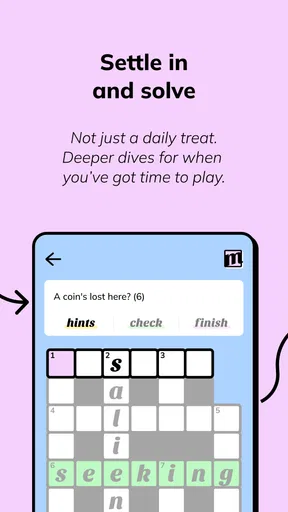
Compared with a standard crossword, Minute Cryptic asks for a different kind of attention. A crossword gives me crossing letters that gradually narrow the possibilities. Here, the clue itself carries more of the burden, so I cannot rely on a grid to rescue a weak first guess. That makes the experience more self-contained and more dependent on interpreting the wording accurately.
Compared with a simple anagram game, it is less about rearranging visible letters and more about discovering the instructions hidden in the clue. Anagram games can be satisfying when I want quick pattern recognition. This game is the better pick when I want to understand why a particular answer is correct. The cost is that it demands more patience and may feel slower during a low-energy moment.
Compared with an unlimited word search, the daily structure gives the experience more shape. I am not scrolling through endless rounds or chasing a high volume of solved words. That restraint helps the puzzle remain memorable, but it also means the game cannot satisfy every kind of word-game appetite. If I want a long session with constant new boards, I would choose another category of app.
Minute Cryptic also differs from vocabulary quiz games because knowing an obscure word is not the only route to success. The clue’s construction can guide me toward the answer, and the explanation of the wording is part of the reward. Still, vocabulary matters at the edges, especially when a synonym or abbreviation is unfamiliar. I see that as a gentle reason to learn from missed clues rather than as a barrier that makes the game inaccessible.
Who should try it and who should pass
I recommend it to first-time cryptic solvers who like wordplay but are nervous about committing to a large crossword routine. The single-clue format gives enough space to learn without placing a whole puzzle grid in front of me. It is also a good fit for experienced players who want a compact daily exercise rather than another sprawling game demanding regular sessions.
I would be more cautious about recommending it to someone who wants a purely casual game with no learning curve. The store summary presents the experience as fast and accessible, and I agree that the entry point is approachable, but accessibility does not mean every clue will be instantly transparent. The player still has to learn how definitions and wordplay share space.
The Teen rating is worth keeping in mind for families choosing games for younger children. A parent should decide whether the child is comfortable with the reading level and the style of puzzle, rather than assuming that a word game is automatically suitable for every age. For adults and older teenagers who enjoy language puzzles, the rating should not be a practical obstacle.
The free price makes experimentation easy, particularly for someone who has never tried a cryptic format. I can give it a fair chance without first deciding whether a larger puzzle subscription is worthwhile. My advice would be to play several daily clues before forming an opinion. One difficult clue can create a poor first impression, while a short run gives me a better sense of whether I enjoy the solving method.
My verdict after settling into the format
Minute Cryptic succeeds because it keeps the promise small and specific: one word puzzle that can fit into an ordinary day, but that may stay in my thoughts longer than its size suggests. I like that it encourages careful reading instead of rewarding only speed. The strongest moments come when a strange-looking phrase suddenly reveals its purpose and the answer feels earned rather than guessed.
Its limitations are closely tied to that same focus. The daily structure will not satisfy everyone who wants unlimited content, and cryptic clues can still frustrate players expecting straightforward word matching. The game is not my first choice when I want a mindless distraction. I reach for it when I have enough attention to test an interpretation, revise a guess, and appreciate the construction behind the solution.
For a first session, I would install it, read the clue twice, identify the likely definition, and write down one candidate with a reason behind it. If I am stuck, I would leave the puzzle for a while rather than flooding the answer with guesses. That simple process makes the first meaningful success feel attainable and teaches a habit that remains useful on later days.
Overall, I think this is a thoughtful free word game for curious beginners and regular puzzle fans who value a compact challenge. Its 4.4 average and growing install base suggest that the format is connecting with players, while the small number of written reviews means my own experience matters more than relying on a crowd consensus. I would recommend giving Minute Cryptic a try if the idea of decoding one carefully written clue sounds satisfying. If that sounds like work rather than play, a faster anagram or unlimited word game will probably be a better match.
Verdict
Strengths of Minute Cryptic
- Fresh cryptic clues offer a satisfying daily mental challenge.
- Short solving sessions fit easily into busy routines.
- Hints help beginners learn cryptic clue techniques.
- Clean interface keeps attention focused on the puzzle.
- Daily puzzles encourage a consistent solving habit.
Limitations of Minute Cryptic
- The daily limit may disappoint players wanting more puzzles.
- Some clues rely on wordplay that can feel highly subjective.
- Difficulty can vary noticeably from one puzzle to another.
- Limited content may reduce long-term appeal for frequent solvers.
- Cryptic conventions can be intimidating without prior experience.
Similar Picks in This Category
View All
Word Search - Word Puzzle Game
Bluetile4.8

Word Search Quest - Puzzles
Blackout Lab4.8

CodyCross: Crossword Puzzles
Fanatee, Inc.4.7

Words of Wonders: Crossword
Fugo Games4.9

Wordscapes: Word puzzle game
PeopleFun4.7

Word Search Explorer
PlaySimple Games4.9
Frequently Asked Questions
What is Minute Cryptic?
Minute Cryptic is a compact daily cryptic crossword game designed for players who enjoy solving clues but do not always have time for a full puzzle. Each challenge typically focuses on a small number of carefully written clues, combining definitions, wordplay, abbreviations, and letter manipulation. It is a good introduction to cryptic crosswords, while still offering enough cleverness to challenge experienced solvers.
How does Minute Cryptic work?
The game presents a short cryptic puzzle that you solve by interpreting both the direct definition and the hidden wordplay in each clue. Answers may involve anagrams, reversals, homophones, deletions, or combinations of letters. You enter your solution directly and can usually use the surrounding clues and answer lengths to guide your reasoning. The short format makes it convenient for a quick daily session.
Is Minute Cryptic suitable for beginners?
Yes, Minute Cryptic can be suitable for beginners, although cryptic crossword conventions may initially feel unfamiliar. The puzzles are brief, so learning the common indicators and solving techniques does not feel overwhelming. New players should expect to make mistakes and may need hints or explanations while learning. Anyone who enjoys word games, vocabulary challenges, or lateral thinking will likely find the learning process rewarding.
Does Minute Cryptic require an internet connection?
The need for an internet connection may depend on the platform version and how the game delivers its daily puzzles. Some content may be available after it has loaded, while new challenges, updates, statistics, or synchronization can require online access. Before downloading, check the current store description and permissions for your Android or iOS device, especially if you plan to play while traveling or with limited connectivity.
Is Minute Cryptic free to download, and are there advertisements or purchases?
Availability, pricing, advertising, and optional purchases can vary according to the Android or iOS release and may change over time. Some versions may provide the core daily puzzle at no cost, while additional archives, hints, or premium features could require payment. Review the official app-store listing before installing, and check whether subscriptions, in-app purchases, or advertisements are included in the version offered in your region.
Play our best games!


